Buying Aviation Software: A Practical Playbook for Airline Tech Ops

Why Most Airlines Buy the Wrong Maintenance Software (And How to Get It Right)
Every airline has felt it: the sting of investing in a new system that looked great in a demo, promised a brighter future, and then quietly added to the problems the moment real operations touched it.
Because in aviation, software isn’t just software.
It’s communication.
It’s response time.
It’s compliance.
It’s revenue.
And when you buy the wrong tool?
You don’t just lose money you lose minutes and seconds off the clock of a game where the seconds matter.
Minutes your fleet can’t spare.
This guide breaks down how airlines can buy aviation maintenance management software the right way—with clarity, discipline, and operational truth.
The Real Problem is The Time You’re Losing Jumping Between Tools
A narrow-body aircraft costs $600–$1,100 every five minutes it's on the ground.
And more than 25% of avoidable delay minutes trace back to one root cause:
communications and process breakdowns between MCC, line maintenance, engineering, and station teams that create what we call "micro-delays."
Think about it. You have countless events per day, and each micro-delay spend searching for context between emails, then back to M&E, then over to teams chats...
Over the course of the day, those micro-delays turn into large delays. Large delays mean large problems.
You can upgrade systems for years and never fix that problem, unless you first define it clearly.
Airlines often jump to solutions:
- “We need better alerts.”
- “We need to build this in house”
- “We need cleaner dashboards and more data.”
But those are symptoms.
The real issue is always time:
- Lost time chasing updates across multiple channels
- Lost time waiting for engineering to see the real issue
- Lost time recreating context from scratch at every shift change
You cannot buy the right software if you aren’t brutally honest about where the leak in the frame is today.
Start with the last 90 days of delay codes.
Classify delays by breakdown type: communication, coordination, parts availability, troubleshooting, etc.
You’ll find the truth quickly.
Most airlines do.
Build Alignment Before You Build a Shortlist
Aviation software doesn’t fail because of missing features.
It fails because teams weren’t aligned when they bought it.
In every successful airline implementation, five groups were involved from day one:
- Maintenance Control — owns the operational tempo and triage
- Line Maintenance — knows what happens ion the ground and real-time effects
- Engineering — understands technical flow and escalation paths
- IT — governs integrations, security, data architecture
- Finance — models cost, benefit, and operational ROI
Skip one, and something breaks later.
The smartest teams define the shared outcome before evaluating a single vendor:
“Reduce AOG/OOS resolution time by 20% and give every stakeholder real-time visibility inside one system.”
Once that sentence exists, everything else falls in line:
- Requirements
- Integrations
- Pilot scope
- Budget
- Adoption plan
No more competing agendas.
No more miscommunication.
Just a unified target every team is rowing toward.
Turn Your Needs Into a Requirements Matrix (Your Demo Bullsh*t Filter)
The moment vendors enter the chat, the risk skyrockets.
Everyone’s demo looks great.
Everyone promises “easy integration.”
Everyone claims “airline-grade reliability.”
The only way to cut through the noise is to build a requirements matrix:
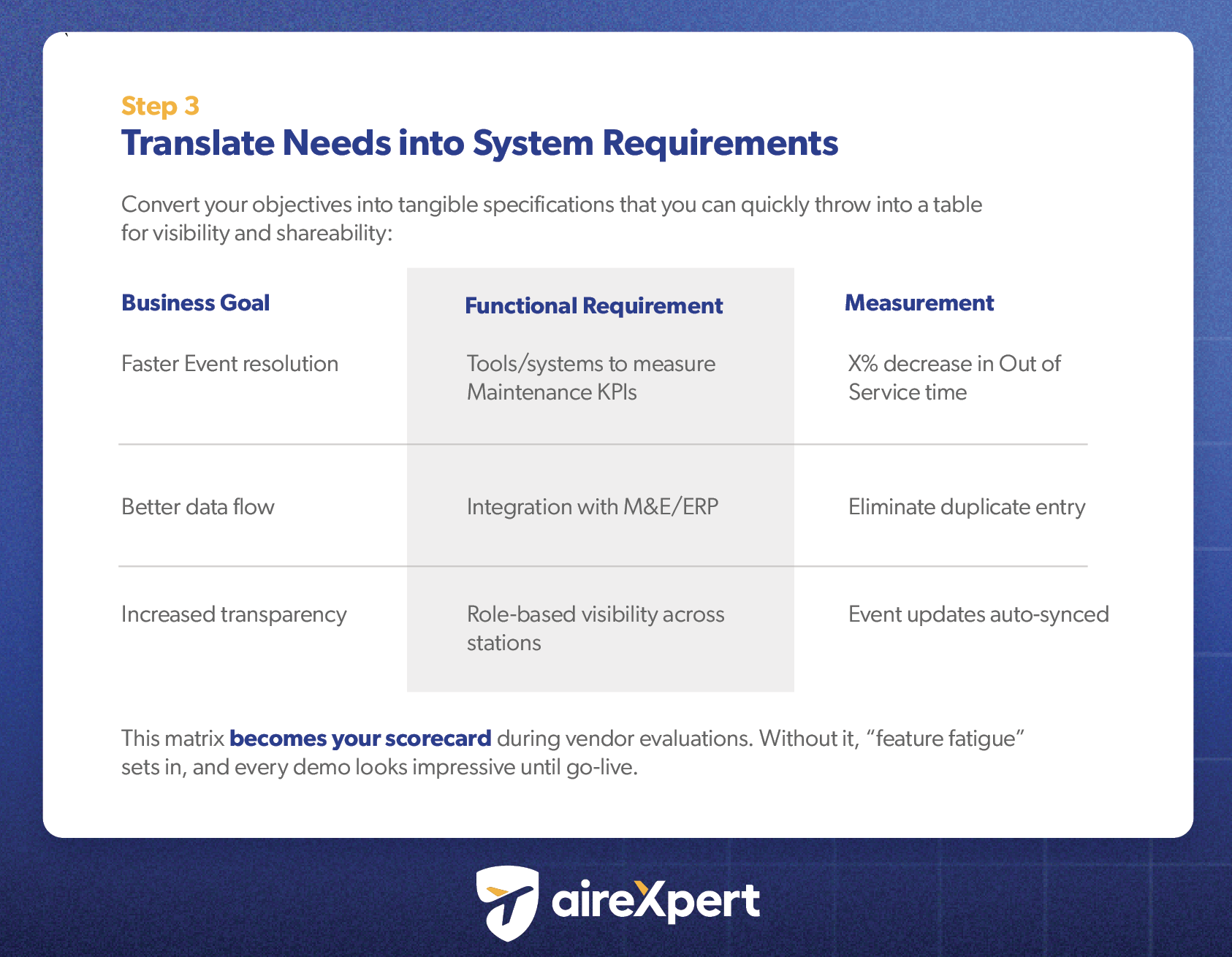
This matrix becomes your compass.
If a vendor can’t hit the requirement tied to your KPI?
They’re out. No emotion. No politics. No “but we liked them.”
This is how mature airlines evaluate software.
And it works.
Judge Vendors by Their Operational Fit and Not Their Feature List
Buying maintenance software isn’t like buying marketing tools or CRMs.
Aviation has higher stakes, more complexity, and zero margin for downtime.
So the evaluation lens must be different.
Airlines that choose well evaluate vendors across five dimensions:
- Integration reality — Not “we have an API,” but “here’s how it integrates with your M&E system.”
- Operational depth — Can MCC, engineering, and line technicians all use it?
- Scalability — Will it hold up when you add aircraft, outstations, or new workflows?
- User experience — If a technician needs training to log an event, adoption will die.
- Partnership — Not “support tickets,” but “operational reliability as a shared goal.”
The strongest vendors bring operational credibility, not just modern UX.
They understand how technicians think, how MCC communicates, and how engineering escalates.
And they adapt the tool to the airline—not the airline to the tool.
Run a Pilot That Proves ROI Fast
Every vendor will promise ROI.
Only a data-backed pilot can prove it.
A proper pilot should aim to validate improvements like:
- 15% faster event response time
- 25% fewer duplicate updates
- 100% traceability from event initiation to resolution
Pick one base, one fleet, or one shift.
Keep scope small but measurable.
Document everything.
Your pilot should answer five questions:
- Did this improve our KPIs and reduce downtime?
- Did this improve communication speed?
- Did technicians adopt it without friction?
- Did it eliminate manual work?
- Would the operation feel unsafe or slower without it?
If you can’t answer “yes” to at least four, the tool isn’t ready for scale.
Be Honest About Build vs Buy
Airlines often consider building custom software to control their workflow.
But aviation history is full of abandoned systems, unsupported custom code, and legacy tools no one knows how to maintain.
The numbers tell the story:
- 70% of custom enterprise software is rewritten or abandoned within 5 years
- 80% of the total cost of ownership is in support, not development
- SaaS delivers 50–70% faster time-to-value than custom builds
Internal teams get stretched thin.
Outstations get left behind.
Enhancements slow down.
Tribal workflows emerge.
Meanwhile, SaaS systems evolve continuously—because entire teams of engineers are dedicated to keeping them modern and resilient.
For most airlines, the question isn’t “can we build it?”
It’s “can we maintain it for the next 10 years without compromising safety or operations?”
Usually, the answer is no.
The Five Pitfalls That Sink Most Airline Software Projects
Here’s where things usually go wrong:
1. Feature Shopping
Buying the most features instead of the right workflows.
2. Underestimating Implementation
Go-live should be treated like an induction checklist: phased, validated, audited.
3. Ignoring Adoption
A tool nobody uses is worse than no tool at all.
4. Bad Data Hygiene
Dirty data makes even the best software look broken.
5. Vendor Over-Dependence
If every change requires a support ticket, you bought a service—not a system.
Avoid these, and your odds of success rise dramatically.
If You Want Faster, Safer, More Predictable Ops You Need to Buy With Precision
Buying aviation maintenance management software isn’t a shopping exercise.
It’s an operational inflection point.
The airlines that choose well do five things differently:
- Define the real problem, not the symptom.
- Align Ops, IT, Finance, and Line before evaluating anything.
- Filter vendors through measurable outcomes, not emotion.
- Run a disciplined pilot that proves ROI quickly.
- Avoid the pitfalls that kill adoption and impact.
When you buy this way, you don’t just acquire a tool—
you create an operational advantage.
And in aviation, an advantage is worth minutes.
Minutes are worth money.
Money is worth margin.
Margin is worth survival.
Ready to Modernize Your Tech Ops the Right Way?
If you're evaluating your next maintenance management platform and want a partner who understands the reality of operations—not just the software behind them—our team is here to help.
Chat with AireXpert, and we’ll work with you to define KPIs, structure a pilot, and prove ROI in real operational minutes.
Subscribe for updates



Every fact, every interaction, every choice and every voice. In one place.