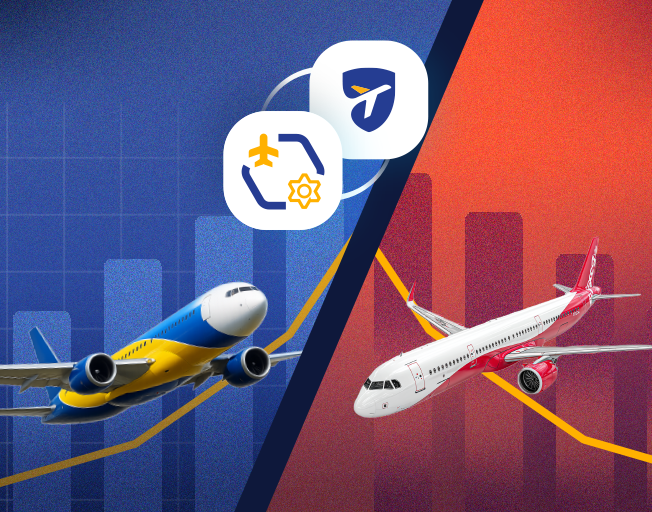
When Solar Flares Knocked out Two Airbus Operators, They Had Radically Different Results
A rare solar-radiation anomaly triggered an emergency directive requiring immediate software reversions across thousands of Airbus aircraft. For airlines operating large A320-family fleets, the directive created an abrupt operational challenge: dozens to hundreds of aircraft required service before they could return to flight.Two carriers of similar size—referred to as Airline One and Airline Two—experienced the same technical issue. Both had comparable Airbus narrowbody footprints, similar route structures, and similar staffing levels. Yet the disruption played out very differently for each operator.While Airline One restored the majority of its affected aircraft in a matter of hours, Airline Two navigated prolonged operational turbulence lasting more than a week.This case study explores why.
Two major carriers, two drastically different results. The difference? The tools and technologies used to manage it.

The Trigger Event
The Solar-Radiation Software Impact
Solar activity caused data integrity issues in specific Airbus flight-control systems. Regulators issued a mandatory rollback that grounded affected aircraft until a verified fix could be applied.
Airlines had to respond immediately:
- Identify all impacted aircraft across their networks
- Coordinate engineering and maintenance at multiple stations
- Communicate evolving status updates to SOC, crews, stations, and leadership
- Adjust schedules, aircraft assignments, and customer communications in real time
For many carriers, it became a systemwide stress test of their event coordination capability.
Airline One: A Rapid, High-Visibility Response
Fleet Impact
Airline One had well over one hundred Airbus narrowbody aircraft requiring immediate software rollback. This represented a meaningful percentage of its operation.
Operational Response
Airline One initiated a coordinated response using a centralized Tech Ops event management system already native to its internal workflows.
This enabled:
- Instant fleetwide visibility into which aircraft were grounded and where
- Clear ownership for each maintenance event
- Real-time progress updates as software reversions were completed
- Auto-escalation pathways to resolve delays without manual oversight
- Shared situational awareness between Tech Ops, Engineering, MCC, SOC, and station teams
Outcome
Within a very short window, Airline One returned the majority of affected aircraft to service. Disruption was largely contained to the first day, and operational stability returned quickly.
The speed of recovery was not coincidental—it reflected structural readiness.
The systems that governed day-to-day events scaled seamlessly during a fleetwide emergency.
Airline Two: A Prolonged, Fragmented Recovery Process
Fleet Impact
Airline Two had a slightly smaller Airbus narrowbody fleet than Airline One, but the percentage affected was similar. Dozens upon dozens of aircraft required immediate action.
Operational Response
Airline Two coordinated its response through traditional channels:
- Email chains
- Group messaging threads
- Phone calls between stations
- Locally managed spreadsheets
Each tool solved a specific problem, but collectively they introduced bottlenecks:
- Information delays created uncertainty about aircraft readiness
- Conflicting updates surfaced as multiple versions of the truth
- Duplicate work occurred when teams reacted without shared visibility
- Network planning fell behind because data was incomplete or outdated
Outcome
Without a unified operational picture, Airline Two’s recovery required over a week. The airline also temporarily limited new bookings to stabilize its operation.
Even as technical work was completed, schedule disruption cascaded across days because decision-makers lacked immediate clarity on aircraft status. The response was driven by effort, not by system support—and the recovery timeline reflected that.
What This Comparison Reveals
1. The technical issue was identical. The operational friction was not.
Both airlines faced the same directive and similar scopes of aircraft grounding. The divergence came from how effectively each could coordinate events in real time.
2. High alignment reduces disruption exponentially.
Airline One’s unified system allowed hundreds of team members—across stations, departments, and time zones—to operate from one shared understanding of the situation.
Airline Two attempted the same work through siloed tools, creating an expanding gap between real aircraft status and perceived aircraft status.
3. The cost of fragmentation compounds rapidly.
Each hour without clarity creates:
- Misrouted tasks
- Repeated work
- Missed opportunities to return aircraft to service
- Additional delays and cancellations
By the end of the first day, the difference in recovery velocity between Airline One and Airline Two was already irreversible.
Lessons for Airlines Operating Airbus Narrowbodies
Lesson 1: Situational visibility is the foundation of rapid recovery.
Without real-time insight at the fleet level, even well-staffed teams will struggle.
Lesson 2: Event ownership must be clear before a crisis, not during it.
Airline One succeeded because its workflows were already defined—no improvisation required.
Lesson 3: Multi-channel communication is the enemy of operational speed.
Email + chat + calls + spreadsheets = invisible bottlenecks.
Lesson 4: Tech Ops event management isn’t just a tool—it’s a resilience strategy.
The difference between a short-lived disruption and a 10-day recovery can be traced directly to event management maturity.
Conclusion: Resiliency Is Built Before the Crisis, Not During It
Airline One didn’t outperform because it worked harder.
It outperformed because it was structurally prepared.
Airline Two didn’t struggle due to lack of expertise.
It struggled because it lacked alignment.
When disruptions scale across tens or hundreds of aircraft, the determining factor is not the technical fix—it’s the operational coordination that surrounds it.
An effective Tech Ops event management platform turns a fleetwide emergency into a manageable operational challenge.
Without one, even small disruptions can spiral into multi-day instability.